
Your back hurts. It might feel like something shifted, something is out of place, or something is broken. You find yourself stuck in one position because it’s the only one that doesn’t hurt. You’re thinking about the MRI you haven’t gotten yet. You’re thinking about the word disc. You’re wondering if you’re going to need surgery.
I have heard this presentation hundreds of times throughout my career. And almost every time, the answer is the same: your back is not broken, nothing is out of place, and you are going to be okay.
What you might not know is that the physical therapy profession has published over 5,800 peer-reviewed studies on low back pain — spanning more than 70 years of research, dating back to 1952. That is more than any other profession in healthcare, and it is not close. Last year alone, the profession published 465 new studies — that is 9 new peer-reviewed papers every single week, just on back pain. And that is just back pain. This is one of the many things we study, publish on, and treat every day.
The good news is now you know. The bad news is you may have been wasting your time and money not seeing a Doctor of Physical Therapy who practices by the most current clinical standards.
Nothing Is “Out of Place”
Your spine did not slip out of alignment. Your disc did not “go out.” Your vertebrae did not shift. I know it feels that way — the pain is sharp, it’s positional, and it came on suddenly. But the human spine is an incredibly strong, stable structure held together by layers of ligament, muscle, and fascia. It does not just come apart. Something is not out of place. Something is irritated, sensitized, and overloaded — and that is something we can treat.
The language we use around back pain matters. When someone tells you something is “out of place,” your brain hears damage. It hears fragile. And that belief — that your back is fragile and broken — is one of the strongest predictors of whether your pain becomes chronic — meaning you tell yourself you have a “bad back” for the rest of your life. Not the MRI. Not the X-ray. Your belief about what is happening. This is not opinion — it is one of the most replicated findings in pain research (Wertli et al., Spine, 2014; Darlow et al., Pain, 2012).
What About the Disc?
Discs can bulge. They can herniate. And when they do, it can hurt — a lot. But here is what the research consistently shows:
Researchers MRI’d over 3,100 people with no back pain at all. The “abnormal” findings included disc bulges, disc protrusions, disc degeneration, annular fissures (tears in the outer disc wall), facet joint degeneration, and spondylolisthesis — the kinds of things that sound serious on a radiology report. Here is how common they were in people who felt completely fine (Brinjikji et al., AJNR, 2015):
| Age Group | Abnormal MRI Findings | Pain / Symptoms |
| 20s | 37% | None |
| 30s | 52% | None |
| 40s | 68% | None |
| 50s | 80% | None |
| 60s | 88% | None |
| 70s | 93% | None |
| 80s | 96% | None |
Every person in that table had no pain. These are not injured backs. These are normal backs.
That does not mean your pain is not real. It means that what the MRI shows and what you feel are often two completely different things. The things on your MRI were probably there before your pain started, and they will probably still be there after your pain is gone. An MRI is a picture. It is not a diagnosis. And this is why spinal injections and spinal surgeries are among the least effective of all elective procedures in the United States — because they are often targeting findings that were never the source of the pain in the first place. A review of every randomized controlled trial on lumbar fusion concluded: “The available evidence does not support a benefit from spine fusion compared to non-operative alternatives for back pain associated with degeneration” (Harris et al., Internal Medicine Journal, 2018).
What We Actually Do
First, we listen. We sit down and talk to you — for as long as it takes. Where does it hurt, when did it start, what makes it worse, what makes it better, what you have tried, what you are worried about. This is the subjective exam, and most people are surprised by how much time we spend here. It matters. The details you share are what let us connect the dots.
Then, we put our hands on you. The objective exam — testing your movement, your strength, your reflexes, your nerve function — tells us what is actually going on and what your body needs right now.
Then, we treat you. Same visit. Based on those findings:
- Manual therapy — hands-on work to reduce muscle guarding and calm the pain down
- Joint mobilizations and joint manipulations
- Traction to decompress and relieve pressure
- Dry needling depending on your symptoms
- Exercises in the clinic to start restoring movement
- A home program so you keep making progress between visits
The goal is to get your pain levels down so you can begin to move normally again. For most people, that happens within a few days. From there, we teach you how to decrease your chances of this happening again.
You Do Not Need a Referral
Wisconsin is a direct access state. That means you can call us directly, and we can often get you in the same day. Yes — the same day, with a Doctor of Physical Therapy. We bill your insurance the same way we would if your doctor had sent you to us. The only difference is you did your research, called us first, and got seen without wasting time or money.
Here is what both paths look like:
THE TYPICAL PATH
1. Back hurts
2. Call your doctor — wait for appointment
3. Doctor visit — charge
4. Ordered an MRI — charge
5. Wait for MRI appointment (weeks)
6. Wait for results
7. Follow-up with doctor (weeks) — charge
8. Referral to PT
9. Wait for PT appointment in system (weeks)
$600–$4,000+
in charges
3–5
appointments
3–5
days off work
4+ weeks
in pain without seeing a PT
DIRECT ACCESS
1. Back hurts
2. Call Forward PT
3. See a Doctor of Physical Therapy — often same day
4. Treatment starts immediately
1 charge
one visit
1
appointment
0
days off work
Same day
treatment starts
Your back is not broken. Let us show you.
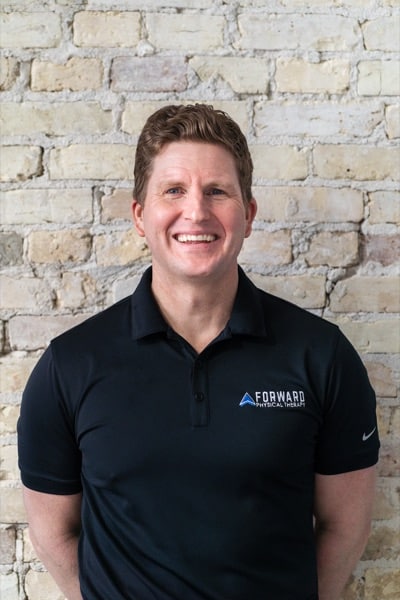
Jedd Wellenkotter, PT, DPT, MS, EPC
Co-Owner | Head of Clinical Operations & Technology
Doctor of Physical Therapy, exercise scientist, and the developer behind Return+ and Lune.