
A 2025 systematic review in the Journal of Orthopaedic & Sports Physical Therapy — the profession’s leading research journal — just confirmed what we have known for 30 years: rotator cuff tears show up on imaging in people with no pain, no weakness, and no symptoms. 53 studies. Literature searched through September 2024. The finding has not changed. And most patients still do not know about it.
You got an MRI. It shows a rotator cuff tear. Your doctor says you need surgery. But does the tear actually matter?
What the Research Shows
Rotator cuff tears show up on MRI in people who have no pain, no weakness, and no functional limitation. This has been documented consistently for 30 years:
- Sher et al., JBJS, 1995 — 34% of asymptomatic volunteers had rotator cuff tears on MRI. The prevalence increased with age: 54% of subjects over 60 had tears with no symptoms (PubMed).
- Tempelhof et al., JBJS, 1999 — 23% of asymptomatic shoulders had full-thickness rotator cuff tears on ultrasound. Over age 70, the rate exceeded 50% (PubMed).
- Minagawa et al., Journal of Orthopaedics, 2013 — Population-based screening of 664 shoulders in a Japanese village found rotator cuff tears in 20.7% of all subjects. Two-thirds of those tears were completely asymptomatic (PubMed).
- Teunis et al., JBJS, 2014 — Systematic review found that the prevalence of rotator cuff tears on imaging increases with age regardless of symptoms. Tears are a normal part of aging for many people (PubMed).
- JOSPT, 2025 — The most recent systematic review: 53 studies, literature searched through September 2024. Full-thickness tears present in up to 14% of asymptomatic people. Partial tears or tendinopathy in up to 65%. Over age 80, up to 50% have tears with no symptoms (PubMed).
Thirty years of research. The finding has not changed. Rotator cuff tears are common, they increase with age, and a large percentage of them cause no symptoms at all.
So Why Does This Matter?
Because an MRI finding drives decisions. A patient has shoulder pain, gets an MRI, the MRI shows a tear, and the conversation shifts to surgery. But the tear may have been there for years before the pain started. The tear may not be the source of the pain at all.
Shoulder pain has many contributors — weakness in the rotator cuff and surrounding musculature, poor tissue extensibility, joint stiffness, upper and mid back stiffness, cervical referral, deconditioning, central sensitization. And beyond the shoulder itself: obesity, blood glucose, aerobic fitness, how much you exercise, how well you sleep, how you use your arm at work. A rotator cuff tear on MRI does not rule out any of these. It just gives everyone something to point at.
The question is not whether the tear exists. The question is whether the tear is causing the problem. That distinction can only be made by a thorough clinical evaluation — not by an image.
Does Surgery Fix It?
For some tears, yes. Acute traumatic tears with significant weakness and functional loss often benefit from surgical repair. But these are not the majority of tears. Most rotator cuff tears develop gradually over time — and for those, the evidence tells a different story.
- Kukkonen et al., Bone & Joint Journal, 2015 — Randomized trial comparing surgical repair vs. exercise therapy for degenerative supraspinatus tears. No significant difference in outcomes at 1 year (PubMed).
- Lambers Heerspink et al., JBJS, 2015 — RCT comparing surgery vs. conservative care for degenerative rotator cuff tears. No clinically relevant difference at 1 year (PubMed).
- Kuhn et al., JBJS, 2013 — Patients with chronic full-thickness rotator cuff tears who chose physical therapy had significant improvement. 75% were satisfied and did not cross over to surgery at 2 years (PubMed).
This does not mean surgery is never indicated. It means surgery is not automatically indicated just because a tear exists on imaging.
460,000 Per Year and Climbing
The United States performs over 460,000 rotator cuff surgeries per year. The volume increased 141% in a single decade. Countries with comparable healthcare systems perform these procedures at significantly lower rates — and their populations are not walking around with worse shoulders.
The pattern is the same one driving spine surgery overuse: more imaging leads to more findings, more findings lead to more procedures, and financial incentives favor surgery over conservative care. When the question changes from “does this patient need surgery?” to “does this MRI show something I can operate on?” the volume goes up, but the outcomes do not improve.
Other countries manage rotator cuff pain conservatively as a first-line approach more often than the US does. The shoulders are the same. The evidence is the same. The difference is how the system responds to a finding on an image. And who you see first matters. If the first person you see after your shoulder starts hurting is a surgeon, the conversation starts with surgery. If the first person you see is a physical therapist who examines the joint, tests the strength, and evaluates the whole picture — the conversation starts with what is actually causing the problem. The entry point shapes the outcome. The data backs this up: patients who access physical therapy first receive fewer imaging orders, fewer injections, fewer surgical referrals, and fewer surgeries — while achieving equivalent or better outcomes. In one study, none of the patients in the PT-first group underwent surgery during the follow-up period. Physical therapists ordered imaging within 28 days only 3.3% of the time, compared to 18% for primary care providers (IJSPT, 2022). Each patient seen through direct access cost the payer $1,543 less on average (JOSPT, 2018). Who you see first changes everything.
What Should Happen First
A hands-on examination of the actual joint. Not an image of it — an examination. Someone needs to put their hands on your shoulder and test it. How much force can the cuff produce? Does it match the other side? How far does the joint move — actively and passively? Is the upper and mid back stiff? Is the neck referring pain into the shoulder? Is there neural tension through the arm? What does grip strength look like?
But the examination does not stop at the joint. What is your BMI? Your waist-to-hip ratio? Your aerobic fitness — have your ventilatory thresholds been tested? How well do you sleep? How much water do you drink? What does your diet look like? Do you exercise outside of therapy? What are the demands of your job — overhead work, desk work, heavy lifting? How is your stress? All of these influence tissue healing, pain sensitivity, and recovery speed. A clinician who examines only the shoulder is missing most of the picture.
An MRI cannot do any of that. An MRI shows structure. It does not show function. It does not tell you whether the tear is the source of your pain or an incidental finding that has been there for a decade. It does not tell you whether your shoulder is weak because of the tear or because you stopped using it when it started hurting. It does not tell you whether the pain is coming from the shoulder at all.
The examination answers the question the MRI cannot: what is actually causing this? If the clinical picture matches the imaging — acute traumatic tear, significant measurable weakness, failed conservative care — surgery may be the right path. If it does not match — and it often does not — the tear is incidental, and physical therapy is the first-line treatment. You will not know which situation you are in without someone examining the joint.
The Bottom Line
Your MRI shows a tear. That finding is real. The tear may be the source of your pain — or it may have been there for years before you ever hurt. Either way, it does not automatically mean surgery. It means you need a thorough examination by a clinician who evaluates the whole person, not just the image. If the tear is contributing to the problem, we change the plan accordingly — progressive loading, targeted strengthening, modified activity. If it is incidental, we treat what is actually causing the pain.
I am not anti-surgeon. Surgery saves lives and restores function when it is indicated. But 460,000 rotator cuff surgeries a year and climbing deserves a closer look at whether the right questions are being asked before the decision is made.
And this should not let physical therapists off the hook either. Most hospital-based PT systems do not honor direct access — you still need a referral to get in the door, which means you are seeing a physician first, which means you are getting an image first, which means the conversation has already shifted before you ever see a PT. And when you do get to PT in those systems, how many of them are testing ventilatory thresholds, measuring body composition, screening metabolic health, asking about sleep and nutrition? How many are spending an hour with one patient? Most are splitting time across two or three in 30-minute windows and calling it conservative care.
Finding a physical therapist who practices at the level this evidence demands — in a system built for it — is not easy. That is the problem. And that is what we are building at Forward. We practice direct access. We evaluate the whole person. We test what matters. We spend the time. And we built the software to track every metric because the tools did not exist.
If you are in southern Wisconsin and you want your shoulder evaluated by a team that will look at more than the MRI — start here. No referral needed.
Related: Shoulder Pain Physical Therapy · Rotator Cuff Rehab · Return+ Testing
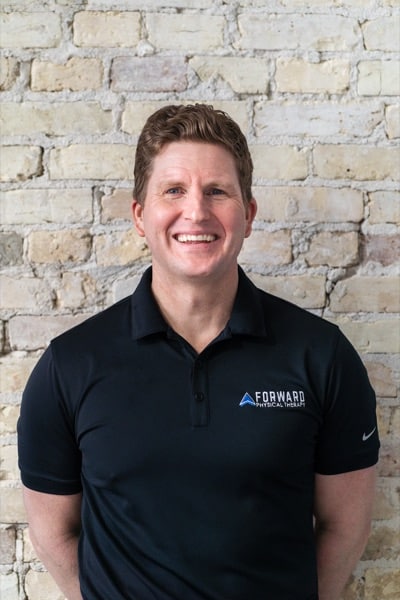
Jedd Wellenkotter, PT, DPT, MS, EPC
Co-Owner | Head of Clinical Operations & Technology
Physical therapist, exercise scientist, and the developer behind Return+ and Lune. DPT from UW-La Crosse, MS in Exercise Science.