
In 2015, a study of six volleyball players changed how a lot of clinics treat tendon pain.
Each player had patellar tendon pain, felt just below the kneecap with squatting and jumping. After five 45-second holds on a leg extension machine at about 70% of a max effort, their pain on a single-leg squat dropped from 7 out of 10 to almost zero, and it stayed that low at 45 minutes, the last time they checked (Rio et al., 2015). Slow weighted leg extensions helped less. Quad strength rose almost 19% right after the holds, and cortical inhibition of the quad decreased.
Isometrics quickly became a standard prescription for tendon pain, often described as an instant fix.
The Research Since
The big effect didn’t replicate. A pre-registered trial used the exact same protocol in 21 people with patellar tendon pain (Holden et al., 2020). Pain dropped 0.9 points out of 10, was gone by 45 minutes, and was no different from moving exercise.
Achilles and elbow. In 91 people with Achilles pain, no version of isometric holds reduced pain on a hop test, and they did no better than isotonic work or rest (van der Vlist et al., 2020). In tennis elbow, isometrics did little better than a wait-and-see group (Vuvan et al., 2020).
In-season athletes improved either way. In 29 athletes training through patellar tendon pain, a month of isometrics and a month of slow weighted exercise reduced pain about the same (van Ark et al., 2016). A smaller in-season trial from the same group did find more relief right after each isometric session (Rio et al., 2017).
The meta-analysis. A 2020 review of 10 randomized trials found isometrics were no better than isotonic exercise, either right after a session or over 12 weeks. In the authors’ words, the big pain drops seen “in a single study of six male volleyball players… have not been replicated” (Clifford et al., 2020).
The dose. Five holds of 45 seconds became the standard prescription. When researchers compared it with other ways of splitting the same work, such as many short holds, the relief was the same (Pearson et al., 2020).
None of this means isometrics don’t work. It means they work about as well as other good tendon exercise, not better, and not instantly for most people.
Why It’s Tendinopathy, Not Tendinitis
“Itis” means inflammation, and for decades tendon pain was treated that way: rest, ice, anti-inflammatories. In 2002 a group of tendon researchers wrote “Time to abandon the ‘tendinitis’ myth,” pointing out that the classic inflammatory cells are usually absent in painful tendons and anti-inflammatory drugs give no lasting benefit (Khan et al., 2002).
The science has moved since. We now know immune cells and inflammatory signals are part of the process in painful tendons (Millar et al., 2021). But it isn’t the kind of inflammation that ice and ibuprofen fix. It’s a tendon whose capacity has fallen behind what you ask of it. That’s why the treatment is load, and why the name is tendinopathy.
The Exercise Science
An isometric is a muscle contraction where the joint doesn’t move. A tendon responds to the force running through it, not to whether the joint moves.
Across 27 studies of tendon adaptation, the type of contraction made little difference. Intensity did: loads above about 70% of maximum changed tendon stiffness substantially, and lighter loads barely moved it (Bohm et al., 2015). The original isometric protocol was a heavy hold, about 70% of a max effort. That is why it is a reasonable tool: it puts heavy load through the tendon when moving under load still hurts too much.
What Does This Mean for You?
The best evidence for patellar tendon pain is a staged program, and isometrics are stage one. In a 2021 trial of 76 people, a program that went from heavy holds, to slow heavy lifting, to jumping and springing, to sport-specific work beat the classic eccentric program on function at 24 weeks (Breda et al., 2021). Patients moved up a stage when their pain on a single-leg squat was 3 out of 10 or less.
How we use them:
- Very irritable tendon. Heavy holds are where we start: a load the tendon accepts today, with pain allowed to rise only a little and settle within a day.
- In-season athlete. Holds before practice are a reasonable way to keep loading the tendon without adding fatigue. Some athletes get a short-term drop in pain; many don’t.
- Everyone else. We don’t stay there. Slow heavy lifting is next, then the spring work the tendon needs for your life: hops for an Achilles, landings for a patellar tendon, gripping for an elbow. We retest along the way and track it in Return+.
Taken together, the research says isometrics are a useful way to load a painful tendon, about as effective as other tendon exercise, and best used as the first stage of a progressive loading program.
At Forward, alongside loading, we use functional dry needling with electrical stimulation, soft tissue mobilization, and joint mobilization and manipulation. The goal is to help patients get better faster, without unnecessary surgery, MRIs or injections.
Every patient also leaves with a home program from Lunavate, our one-of-a-kind, in-house exercise application, so the work continues between visits. Each exercise pairs an animation with our own exercise video. Our Doctors of Physical Therapy use Lunavate to build workouts for specific pain areas, and patients with that type of pain use them. We test and retest every patient, which shows which workouts, and which combinations of workouts, work best for which patients. Over time, each workout is tested and refined across hundreds of sessions with patients who have similar pain, so the program keeps getting better.
Every patient at Forward PT is seen by a Doctor of Physical Therapy, and no referral is needed in Wisconsin.
Related Reading
If you have tendon pain that isn’t improving, we can test it and build a loading program around what we find.
No referral needed in Wisconsin. Same-day and next-day appointments are usually available at both Fitchburg and Edgerton.
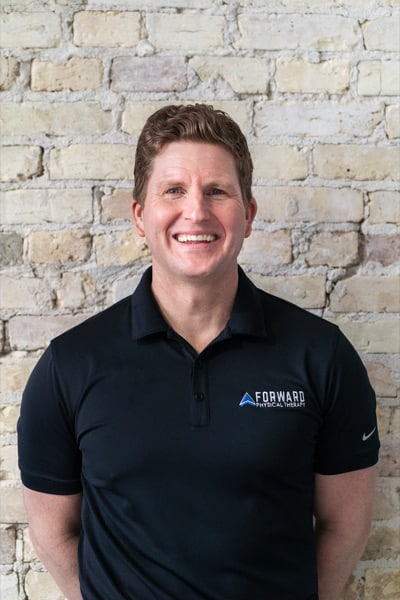
Jedd Wellenkotter, PT, DPT, MS, EPC
Co-Owner | Head of Clinical Operations & Technology
Doctor of Physical Therapy, exercise scientist, and the developer behind Return+, Lune and Lunavate.